
Polling Information
Polling Tips
Illustration on Guidance on Voting Procedure
Ballot Paper Design
(Front Side)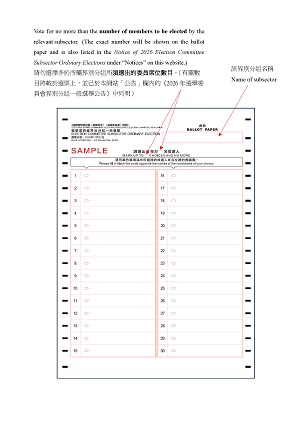
|
(Back Side)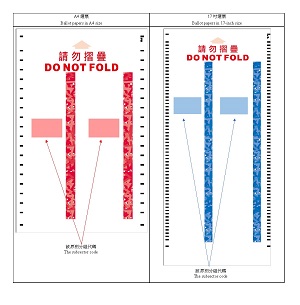
|
|---|
Ballot Paper Classification and Validation System with Votes Counting Automation System
- Ballot Paper Classification and Validation System with Votes Counting Automation System (“BPCVS”)
- Operation mechanism and benefits of Pattern and Image Analysis Technology for Ballot Recognition
- Workflow for the use of counting machines at Central Counting Station
- Independent quality assurance services
Ballot Paper Classification and Validation System with Votes Counting Automation System (“BPCVS”)
Given the large number of seats and candidates in the ECSSOEs, to enhance counting efficiency for a more accurate and smoother counting process, the Registration and Electoral Office (“REO”) has commissioned a contractor to provide the BPCVS, whereby vote counting will be conducted in an automated mode with the aid of counting machines.
The BPCVS makes use of the counting machines with Pattern and Image Analysis Technology for Ballot Recognition to read the choices marked on ballot papers. It also supports manual input of the choices on the questionable ballot papers determined to be valid by the Returning Officers (“ROs”) into the system.
The major counting related components of the BPCVS include:
| Component | Functions |
|---|---|
|
1. Custom Programs of the BPCVS ("Custom Programs") |
|
| 2. Counting Machines |
|
| 3. VBIS |
|
Operation mechanism and benefits of Pattern and Image Analysis Technology for Ballot Recognition
- Pattern and Image Analysis Technology for Ballot Recognition empowers the BPCVS to analyse ballot images and read the marked choices on a ballot paper. After voters marked the designated areas on a ballot paper, the system can identify and input the data into the system effectively and accurately in an automated mode without the need of tedious and repetitive manual efforts. This not only reduces significantly the chance of making mistakes by manual input, but can also reduce operational costs.
- On the counting of votes, counting machines with Pattern and Image Analysis Technology can identify and classify ballots, read the marked choices on the ballots, and convert them into digital data that computers can process. The Custom Programs of the BPCVS will count the votes on valid ballot papers, integrate the data, and store them into the central database.
Workflow for the use of counting machines at Central Counting Station
- After the close of poll, polling staff will deliver the ballot boxes to the Central Counting Station.
- After the opening of ballot boxes by the ROs, counting staff will enumerate the number of ballot papers for verifying with the ballot paper accounts.
- To ensure the secrecy of votes, ballot papers from different polling stations will be mixed and then undergo simple visual screening before they are to be counted.
- Counting machines will be used to validate the ballot papers and count the votes on the valid ones.
- For questionable ballot papers separated during visual screening or scanning, they will be passed to the ROs of the respective subsectors for determination whether they are valid. Candidates and their election or counting agents may make representations during the determination process but the decision of the RO on a ballot paper is final.
- The valid votes marked on each ballot paper determined as valid by RO will be input into the BPCVS manually through VBIS. Counting staff will work in pairs to perform double data entry to ensure the accuracy and reliability of the inputting process.
- Once the Chief Returning Officer (Subsectors) confirms that the vote-counting of the subsector concerned has been completed, the Counting Zone Command Centre will consolidate the counting result through the BPCVS.
- Votes captured by the counting machines and the VBIS will be consolidated through local area network by the BPCVS to form the counting results.
Independent quality assurance services
As in past elections, the REO will ensure that the 2026 ECSSOEs are conducted openly, fairly and honestly. Considering that the BPCVS is the vital part of the Elections, the REO has commissioned four independent quality assurance services to ensure the integrity and reliability of the BPCVS:
- Privacy Impact Assessment
- To evaluate whether the system has potential privacy issues and provide improvement recommendations when necessary.
- Independent Testing Services
- To conduct comprehensive testing on the programs of the BPCVS, including function testing, system integration testing, and load and stress testing, etc.
- Information Technology Security Risk Assessment and Audit Services (“IT SRAA”)
- To provide an information technology security risk assessment and audit on the entire system, including access control, data security, application security, network and communication security, etc.
- Computer Audit Services
- To provide a computer audit on the integrity of the entire automated counting process so as to ensure the BPCVS complies with all relevant requirements, and monitor the integrity, security and accuracy of the data in the BPCVS.
- To audit the test plans, test specifications and test results submitted by both BPCVS Contractor and Independent Testing Services Contractor, and offer advice where necessary.
- To review reports submitted by the other independent quality assurance service providers and offer advice where necessary.
- To monitor the whole counting process at the Central Counting Station.
In addition, the REO has engaged independent consultants via the Digital Policy Office (“DPO”) to conduct additional load and stress tests as well as red team security test for the system.
The contractors of the four independent quality assurance services and the independent consultants engaged via the DPO have completed all pre-production audit / testing on the BPCVS. Final system testing on the BPCVS will be conducted by the contractors at the production site at the Central Counting Station before formal operation of the Central Counting Station.